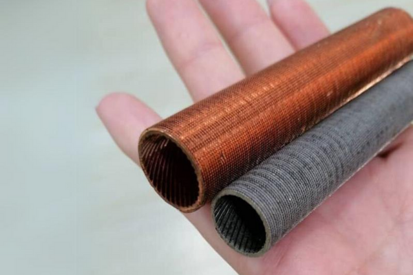
Finned tubes are widely used in heat exchangers where efficient heat transfer is required within limited equipment space. The design of the fins directly affects thermal performance, pressure drop, energy consumption, and the overall efficiency of the heat exchanger.
How Fins Improve Heat Transfer
A fin increases the external surface area available for heat transfer. This is particularly useful when the fluid outside the tube has a lower heat-transfer coefficient than the fluid flowing inside. By adding fins, more heat can be transferred from the tube surface to the surrounding fluid.
Several design factors influence performance, including fin height, thickness, spacing, material, and geometry. Closely spaced fins provide greater surface area, but they can also restrict airflow. Wider fin spacing may reduce resistance while offering less surface area. Therefore, the correct balance is essential for achieving the required thermal performance.
Fin material also matters. Aluminium is commonly preferred for applications requiring lightweight construction and good thermal conductivity, while steel and other materials may be selected when higher mechanical strength or temperature resistance is required.
Effect on Pressure Drop
While increasing fin density can improve heat transfer, it can also increase pressure drop. When fluid passes through narrow spaces between fins, flow resistance increases. This means fans, blowers, or pumps may require additional power to maintain the desired flow rate.
For this reason, finned tube design should not focus solely on maximum heat-transfer area. Engineers must consider the relationship between heat-transfer efficiency and pressure drop. An optimised design provides sufficient thermal performance without creating unnecessary resistance.
Key Design Considerations
The operating temperature, fluid properties, flow velocity, available space, fouling conditions, and required heat duty should all be considered when selecting a finned tube configuration. Proper fin spacing is especially important in dusty or fouling environments because excessively narrow gaps can make cleaning difficult.
Working with experienced finned tubes manufacturers in india can help businesses select suitable materials, dimensions, and configurations according to their application requirements. Similarly, an experienced heat exchanger manufacturer in india can evaluate the complete system rather than looking at fin design in isolation.
Complete Engineering Support from SCES Shrao Engineering
SCES Shrao Engineering provides complete services for heat-transfer equipment, including engineering consultation, design support, manufacturing, fabrication, and application-specific solutions. Its approach focuses on selecting suitable configurations that balance heat-transfer performance, pressure drop, durability, and operating requirements.
Conclusion
Finned tube design has a direct impact on both heat-transfer efficiency and pressure drop. Increasing surface area can enhance thermal performance, but excessive fin density may increase flow resistance and operating costs. A properly engineered design achieves the right balance for reliable and efficient heat exchanger operation.
For application-specific finned tube and heat exchanger solutions, contact SCES Shrao Engineering today to discuss your requirements and get complete engineering support.
FAQs
1. What is the main purpose of fins on tubes?
Fins increase the external surface area of tubes, allowing greater heat transfer between the tube and surrounding fluid.
2. Do more fins always improve heat transfer?
Not always. Higher fin density increases surface area but can restrict airflow, increase pressure drop, and reduce overall system efficiency.
3. How does fin spacing affect pressure drop?
Smaller fin spacing generally increases flow resistance and pressure drop, while wider spacing allows easier fluid movement.
4. Which materials are commonly used for fins?
Aluminium, carbon steel, stainless steel, and other alloys are commonly used, depending on temperature, corrosion, strength, and application requirements.
5. Why is pressure drop important in heat exchangers?
Higher pressure drop increases the power required by pumps or fans, potentially raising operating costs and reducing system efficiency.
6. What factors influence finned tube performance?
Fin geometry, material, spacing, tube diameter, fluid properties, flow velocity, temperature difference, and fouling conditions influence performance.
7. Where are finned tubes commonly used?
They are used in air coolers, boilers, condensers, economisers, radiators, process heaters, and various industrial heat-transfer systems.
8. How can finned tube performance be optimised?
Performance can be optimised by balancing fin area, spacing, material, fluid velocity, thermal requirements, and allowable pressure drop.